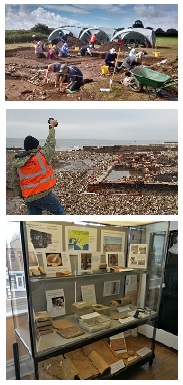
Activities

We arrange events of archaeological interest for our members, including study days and visits to places of interest. Unless otherwise stated, to book a place please contact the activities coordinator at . Please also refer to the latest Chairman's monthly newsletter (available via the Newsletter link) for up to date information on forthcoming events.

2026

Old Idsworth church

Guided Walk - Old Idsworth
led by Mark Seaman

Date: Saturday 20th June, 10.30am

Meeting Point: The entrance to the footpath up to St Huberts Church. There’s limited parking along the side of the road or opposite. Post code: PO8 0BE

Cost: Members £1.00, non-members £6.00 (if places are available) payable in cash on the day. Please book your place in advance by emailing Mark at

Recent archaeological work by CDAS has revealed that the church of St Hubert’s Idsworth (The Little Church in the Field) is built on top of much older buildings and has potentially been used as a sacred site for thousands of years. In the Bronze Age there were numerous round barrows in the area. A complex series of boundary ditches have been found in the field by CDAS. These date to the Iron Age and indicate that there is a pagan temple under the church. When the Romans arrived, they built their own temple on the Iron Age site. Then, with the arrival of Christianity, a wooden church was built on the site. This was followed by the current stone-built church, the western wall of which has a foundation of Roman pilae. A considerable amount of Iron Age, Roman, Saxon and Medieval pottery has been found by CDAS in the field.

It is known that Roman religious cults and then the early church "appropriated" significant locations from previous religions to convert or suppress them, and Idsworth would appear to support this theory. The walk will include Old Idsworth Gardens where permission has been obtained to see its dovecot, icehouse and walled garden. We will also see the unusual and intriguing medieval wall paintings in the church and discuss the interpretation of these.

The walk will be illustrated with Geophys images, other documents and samples of pottery. There will also be a display of the finds by Bart Smith, a metal detectorist. He has found some intriguing items which we can discuss.

The total length is less than a mile. The going is easy with one style (though this can be avoided) and should take about an hour and a half. There are no facilities. Dogs are welcome – St Huberts is dedicated to hunters and hunting dogs! Afterwards, if you would like some refreshment, we can meet in The George, Finchdean, and have a closer look at some of the finds.


Boxgrove Priory

Tour – The history and historic building stones of Boxgrove Priory
led by David Bone and Tim Pullan

Date: Postponed until Spring 2026

Meeting Point: Meet by the south porch of Boxgrove Priory (the Church of St Mary & St Blaise), just east of Chichester (https://www.boxgrovepriory.co.uk/), SU 9082 0750, postcode PO18 0ED. Use the church car park (at the rear of the church, not in Church Lane). If the church car park is full, there is a public car park nearly opposite across the main road (The Street). Good footwear is adequate, wear clothing appropriate for being outside. Toilets are available in the adjacent St Blaise Centre.

Duration: 2 hours, starting at 2pm

Cost: £8 Members, £13 Non-members, £3.50 Student Members (includes a donation to the Priory)

A guided walk to discover both the history of the Priory (part managed by English Heritage) from the early 12th century to the present day, and the stories behind the many different types of building stone used during that time. A tour of the church interior is included.

David Bone is a recognised local geologist with over 50 years of experience. With special interest in historic building stones, he has carried out numerous projects, talks and guided walks that link his interest in geology, archaeology, and history. David is currently Chair of the Sussex Geodiversity Partnership, Chair of the West Sussex Geological Society, and Volunteer Geologist to English Heritage on historic building stones.
Tim Pullan has a BA from Bristol University in History of Art, Archaeology and English, with Barry Cunliffe as a tutor. Tim has worked on excavations at Porchester Castle and Wharram Percy deserted mediaeval village and has now been at Boxgrove for over 30 years. He was joint author of the Millennial Boxgrove village history and of the history of Tortington Priory. Tim is now the choir librarian for the Priory and regularly gives guided tours of the church.

To book a place please contact the activities coordinator at .